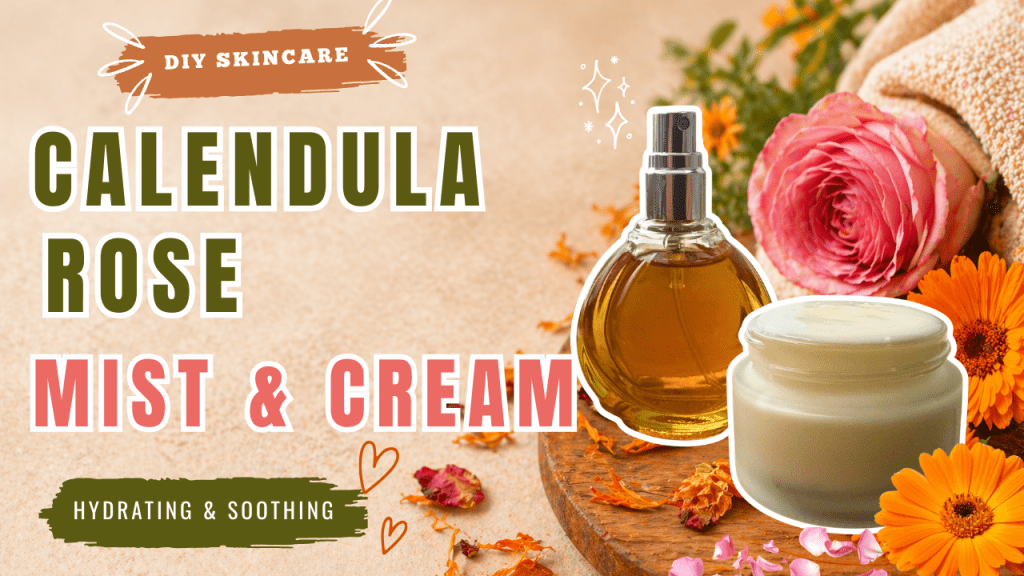
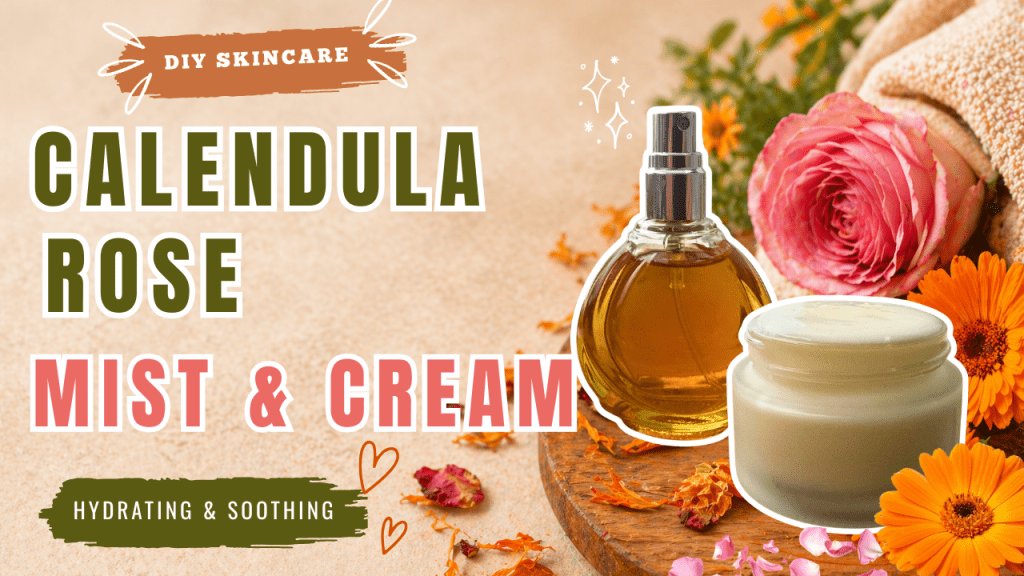
Spring is the perfect time for skincare that feels lighter, fresher, and softer on the skin.
This project brings together two simple floral products for the season: a floral face mist and a light face cream, both inspired by rose and calendula. The mist is fresh and easy to use, while the cream feels soft and light on the skin. Together, they make a simple floral pair that works really well for spring.
Both recipes below are written for a 50 g batch.
Why Rose and Calendula Work So Well in Skincare
Rose and calendula are both beautiful ingredients for floral skincare, but they bring different things to a formula.
Rose is often used in skincare because it helps products feel fresh, soft, and soothing on the skin.
Calendula is especially loved in gentle skincare because it is often used in products meant to calm the skin and support the skin barrier.
Using both together creates formulas that feel floral, soft, and comforting.
Making the Infusions
The first step is making the two floral infusions.
For the cream, an oil infusion is made with rose petals and calendula in jojoba oil. jojoba oil is a great choice here because it is light, so it helps keep the final cream from feeling heavy or greasy.
The flowers are gently heated over a double boiler so the oil can slowly take in the color and some of the properties of the flowers without overheating them. Once the petals soften and the oil turns more golden, it is strained and set aside for the cream.
For the mist, a water infusion is made with calendula flowers and hot distilled water. This becomes the floral water base of the mist. After steeping, the flowers are strained out, leaving a soft golden infusion ready to use.
At this point, both floral bases are ready:
- the oil infusion for the cream
- the water infusion for the mist
Floral Face Mist Formula and Process
This face mist is meant to feel fresh, light, floral, and easy to use.
Floral Face Mist Formula — 50 g Batch
Phase A
- Floral infusion — 45 g
- Panthenol — 0.5 g
- Aloe juice — 2.5 g
- Rose glycerite — 0.5 g
Phase B
- Allantoin — 0.15 g
- Glycerin or Sodium PCA — 1 g
Phase C
- Preservative — 0.3 g
- Chelating agent — 0.05 g
Why These Ingredients Are Used
Floral infusion gives the mist its fresh floral water base.
Panthenol helps the mist feel soothing and hydrating.
Aloe juice helps give it a soft, light, comfortable skin feel.
Allantoin works well in gentle formulas and helps the mist feel more skin-friendly.
Rose glycerite adds more floral character to the formula.
Sodium PCA helps the mist feel more hydrating and fresh.
Preservative is essential because the formula contains water.
Chelating agent helps the formula hold up better over time.
Process
Start by weighing the floral infusion into the beaker.
Then weigh the panthenol and aloe juice, and add them into the infusion.
Next, weigh the allantoin, rose glycerite, and sodium PCA.
The allantoin can be mixed first with a small amount of glycerin if needed to help it go into the formula more easily.
Once those ingredients are added, mix everything together.
Then add the preservative and the chelating agent and mix again.
After that, check the pH.
In this batch, the pH was low at first, around 3 to 4, so a few drops of a 10% arginine solution were added to raise it to 5.
Once the pH is where it should be, pour the finished mist into a spray bottle.
The result is a mist that feels fresh, floral, light, and easy to use.
Floral Face Cream Formula and Process
This cream is light, soft, and comfortable on the skin. It is richer than the mist, but still meant to feel easy to use and not heavy.
Floral Face Cream Formula — 50 g Batch
Phase A
- Distilled water — 34.9 g
- HA solution — 1.5 g
- Rose hydrosol — 4 g
Phase B
- Glycerin — 1.5 g
- Xanthan gum — 0.1 g
Phase C
- Glyceryl stearate SE — 2 g
- Floral oil infusion — 1.5 g
- Rose oil — 1 g
- Cetyl alcohol — 0.5 g
- Squalane — 1 g
Phase D
- Preservative — 0.3 g
- Tocopherol — 0.15 g
- Niacinamide — 1.5 g
- Chelating agent — 0.05 g
Why These Ingredients Are Used
Phase A
Distilled water gives the cream its main water base.
HA solution adds hydration.
Rose hydrosol keeps the floral feel going and helps the cream feel fresh on the skin.
Phase B
Glycerin helps pull moisture to the skin.
Xanthan gum helps thicken the cream and improve the texture.
Phase C
Glyceryl stearate SE helps the water and oil come together and turn into a cream.
Floral oil infusion brings the floral side into the oil phase and adds richness.
Rose oil adds more of the floral side and helps the cream feel softer.
Cetyl alcohol gives the cream more body and a softer texture.
Squalane helps the cream feel smoother on the skin without making it too heavy.
Phase D
Preservative keeps the cream safe to use because it contains water.
Tocopherol is vitamin E and helps support the oil part of the formula.
Niacinamide is a versatile skincare ingredient that works really well in a cream like this.
Chelating agent helps the formula stay in better shape over time.
Process
Start with the water phase.
Weigh the distilled water, HA solution, rose hydrosol, and floral infusion into the main beaker.
Then mix the glycerin with the xanthan gum separately. This helps the xanthan gum go in more easily and more smoothly. Add that mixture into the water phase beaker.
Next, prepare the oil phase.
Weigh the glyceryl stearate SE, floral oil infusion, rose oil, cetyl alcohol, and squalane into a second beaker.
Heat both phases until the oil phase is fully melted.
Then pour the water phase into the oil phase and begin mixing. At first, the mixture will still look quite liquid, but as it mixes, it will turn more opaque and start to thicken into a cream.
Let the cream cool down.
For the cool-down phase, take a small amount of the cream into a separate beaker first. Add the niacinamide, preservative, tocopherol, and chelating agent to that small portion and mix well. Then add it back into the main batch and mix again.
After that, let the cream sit and check the pH.
For this batch, a diluted sample was checked with a pH meter. The pH came out at 5.9, and no adjustment was needed.
Then let the cream finish setting, ideally overnight, before packaging it into a jar.
The final result is a cream that feels soft, light, and comfortable on the skin.
Final Result
Together, these two products make a really lovely spring pair.
The floral face mist feels fresh and light.
The light face cream feels soft and comfortable.
Both are easy to use, easy to enjoy, and designed to work well together.
If you enjoy floral skincare, rose and calendula make a beautiful combination for spring.
The full tutorial is available in the video, where you can follow each step of the process and see how both formulas come together from start to finish.


 Self Care Differently
Laisser un commentaire